◆Please check the website of each gallery for the latest information on the exhibition.
imura art gallery Kyoto

Hideki Kimura Exhibition |
|

《A Couple of Fall》180 X 250 X 5cm 
《Lattice on Grid 10》150 X 110 X 5 cm |
28 Mar.Sat. - 18 Apr.Sat.2026 |
31, Kawabata Higashi Marutamachi, Sakyo-ku, Kyoto, 606-8395, Japan
Tel:+81-75-761-7372 Closed: Sunday, Monday, & National holidays
eN arts
“gaze and pointing”
|
|
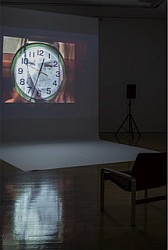 Breeze 2025 |
1 Feb. Sun.– 28 Feb. Sat. 2026 Pointing—directing a finger at something—is often described as the first form of communication infants use before language. Neither a direct bodily action such as touching or grasping, nor an objective verbal expression, pointing exists in between. I am drawn to the particular distance it creates between the self and the world. When making work, I closely observe what I am trying to perceive in an object and how my chosen form shapes the way I see the world. Through this careful observation, different layers of reality come into view. Perhaps this is the pleasure of rediscovering, from the outside, the transparent contours of the world once seen during the infant “pointing” stage. I studied lacquerware in the crafts department at university. Because lacquer is a liquid, it requires a form, and I began by working with wood, a material I loved. However, applying a coating to the surface never felt quite right to me. Looking back, I understand this as a difficulty in prioritizing either form or surface—two inseparable aspects. This experience led to my ongoing interest in the relationship between form and surface. Through my practice, I consider the fact that we can only ever see surfaces, and the questions of presence and absence that inevitably accompany them. Anna Yamanishi “Gaze and Pointing” is a solo exhibition by Anna Yamanishi that focuses on an early, formative stage of our relationship with the world around us – one that cannot be fully reduced to direct physical contact or verbal explanation. Rather than presenting the works as mere sculptural objects, the exhibition establishes them as a site for reconsidering perception itself. The careful examination of what is brought into focus and through what kind of form the world is framed resembles less an act of shaping toward a predetermined result than an attempt to subtly shift the conditions of perception, one by one. The works that emerge from this process do not assert clear meanings or symbols. Instead, they remain suspended at a stage prior to the formation of understanding on the part of the viewer. With a background studying in the field of traditional Japanese lacquerware craftsmanship, Yamanishi encountered early on the difficulty of treating structure and surface as separable entities. Her commitment to engaging “form” and “surface” on equal terms marks a deliberate distance from conventional methodologies that define sculpture as a self-contained, autonomous mass. Rather, her practice can be understood as an effort to reframe sculptural form as a perceptual phenomenon. Yamanishi’s works exist simultaneously as wood carvings – objects with a tangible material presence – and as unstable states that incorporate a sense of openness and indeterminacy. They function as mediating devices that call into question not only the viewer’s assumptions and habits of perception, but also the reliance on outward appearance through which we habitually make sense of the world. This exhibition invites viewers to reflect on the point at which seeing begins and to experience the repeated acts of “gazing and pointing” as acts that unsettle the distance we unconsciously assume between ourselves and objects, as well as the presumed transparency of perception itself. eN arts |
Maruyama Park, Gioncho Kitagawa,Higashiyama-ku Kyoto 605-0073 Japan
Tel:+81-75-525-2355 Open:Friday,Saturday,Sunday
Taka Ishii Gallery Kyoto
Martin Margiela |
|
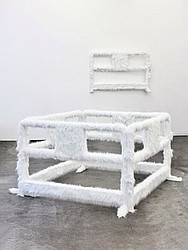 Front: Martin Margiela, 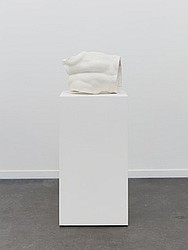 Martin Margiela, |
17 Apr.Fri. - 16 May Sat.2026 Taka Ishii Gallery Kyoto is pleased to present a solo exhibition of artworks by Martin Margiela from Friday, April 17 to Saturday, May 16, 2026. This marks one of his first presentations in Japan, together with his show at kudan house which will be held concurrently in Tokyo. Since 2009, Margiela has been particularly active in expanding the scope of his visual expression outside of fashion. This exhibition presents approximately 14 recent works made between 2018 and 2025. Margiela’s practice is fundamentally grounded in a sustained inquiry into the human body, positioning it as a historically charged site where competing visual and tactile regimes converge. His work reactivates tensions between revelation and concealment, exposure and protection; dynamics that have shaped representations of the body from classical sculpture to contemporary art. In the series of works titled “Tops & Bottoms,” based on marble sculptures from the collection of the Louvre Museum, the canonical nude figures are carved out in the contours of contemporary underwear. By reversing the original function of underwear and exposing what lies within, the sculptures create tension between attraction and alienation. The distinctive textures of each piece in the exhibition, produced from materials Margiela skillfully employs such as carpet and silicone, further activate the sense of touch. Within this framework, fetishism functions as a conceptual strategy, where bodily fragments and material traces become a place of desire and memory, displacing attention from the living body onto material remnants. A pronounced interest in everyday objects, which resonates with historic art movements such as Surrealism and Pop Art, attests to Margiela’s acute observational engagement with the materials of daily life. The “Barrier Sculpture” adopts the shape of protective barriers commonly found in urban environment, but it is uncannily covered with faux fur. Through processes of recontextualization, these objects are elevated beyond their ordinary functions, becoming poetic and enigmatic artifacts. This approach treats found objects as ready-mades that reveal hidden potential. Margiela’s interventions are minimal yet profound, making the ordinary extraordinary while preserving traces of its humble origins, fostering an exercise in attentive looking and cyclical renewal. The works suggest that the life of an object is neither linear nor finite, but subject to continual mutation and reactivation within new contexts. Fragmentation recurs throughout Margiela’s oeuvre, yet they are accompanied by a sense of incompleteness that gives rise to narratives imbued with ambiguity and enigma. “Black Nail Polish,” placed on a stone table near the entrance of the exhibition space, consists of five Nymphenburg porcelain kilns shaped like fingernails; however, the objects that would result from these kilns remain conspicuously absent. Similarly, “Kit (Black)” takes the form of an unassembled plastic model, prompting the imagination to project the completed form that remains unrealized. Through Margiela’s sustained engagement with the unseen and the withheld, the viewer is confronted with incompleteness, silence, and the elusive boundary between presence and emptiness. In this context, concealment and absence are not negations but generative forces, opening the work to unforeseen resonances and moments of unexpected revelation. 【Concurrent exhibition】
MARTIN MARGIELA AT KUDAN HOUSE |
123 Yada-cho Shimogyo-ku Kyoto 600-8442 Tel:+81-75-366-5101
Thu–Sat
10:00–17:30 Closed Sun–Wed and National Holidays

MATSUO MEGUMI+VOICE GALLERY pfs/w
KG+
|
|
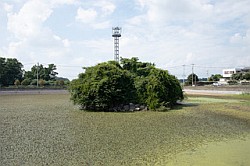 Toki-Senzuka No.2 Kofun / Sakai, Osaka |
18 Apr.Sat. – 3 May Sun.2026 This series is intended to find the way humans live on the layers of the ages, focusing on the ancient burial mounds (called Kofun in Japanese) that exist in the landscape while being irrelevant to the lives of modern people. The ancient burial mounds were built in East Asia, including Japan, as graves where persons in authority sleep a dozen centuries ago. There are many mounds that have been damaged in ways that do not preserve dignity, or are buried in cities and are unable to keep quiet in the urbanization in later generations, especially in modern times. Although the value as a cultural heritage has been recognized and has been the subject of protection and conservation in recent years, there is no buffer between the mounds and the houses, public facilities or public infrastructure due to the already advanced urbanization. The landscape has a strange aspect in which human activities are separated by time and consciousness.(Hayato Nishimura, born in 1977 at Shimane pref.) |
147-1, Sujiya-cho, Shimogyo-ku, Kyoto, 600-8061, Japan
Tel:+81-75-341-0222 Open:11:00-19:00 Closed: Monday, Tuesday
Kyoto City University of Arts Gallery @KCUA
SPECIAL EXHIBITIONS
|
|
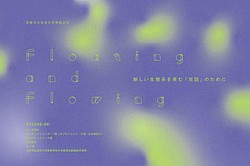 Photo:Kazuki Yoshimoto |
13 Dec.Sat.2025 〜 15 Feb.Sun.2026 Organized by Artist Profiles
Teppei Kaneuji the constructions
Cast: Venue setup and artworks packaging: Seido Ikeda, Atsushi Tsukamoto, Mitsuhiro Kishimoto, Chikara Masuyama, Yosuke Yano, and staff members of KCUA Art Gallery andTOPOS: The Art University as a Garden for Mutual Learning (Mizuho Fujita, Ryosuke Higo, Miharu Seta, Sachiko Uchiyama, Natsuki Yamamoto, Kazuki Yoshimoto) ...and more! (Updated December 8, 2025) |
57-1 Shimono-cho, Shimogyo-ku, Kyoto 600-8601 JAPAN
Tel:+81-75-585-2010 Closed: Monday
MORI YU GALLERY KYOTO
UNDULATIONISM Ⅻ
|
|
 |
8 Nov. Sat- 30 Nov. Sun. 2025 |
4-19,Shougoin-rengezou-cho,Sakyo-ku,Kyoto-shi,Kyoto,Japan,606-8357
Tel:+81-75-950-5230 Closed: Monday, Tuesday & National holidays
Gallery Hillgate
〈1F〉
|
|
 |
31 Mar.Tue.- 5 Apr. Sun.2026 |
〈2F〉
|
|
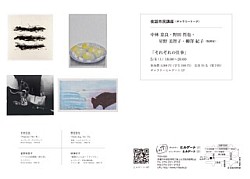 |
31 Mar. Tue.- 5 Apr. Sun.2026 |
〈1F+2F〉
|
|
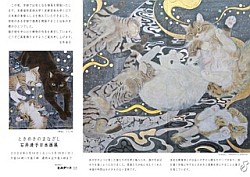 |
7 Apr. Tue.- 12 Apr. Sun.2026 |
〈1F+2F〉
|
|
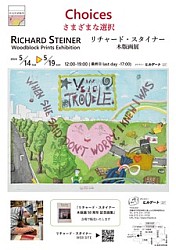 |
14 Apr.Tue.- 26 Apr.Sun.2026 |
〈1F+2F〉
|
|
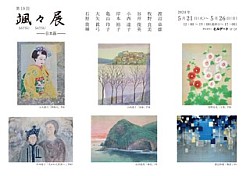 |
28 Apr.Tue.- 3 May Sun.2026 |
〈Back Yard〉
|
|
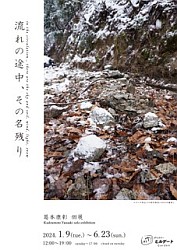 |
12 Jan. Mon.- 14 Jun. Sun.2026 |
535 Sanjo Termachitori. Nakagyo-ku kyoto Japan 604-8081 Tel:+81-75-231-3702 Closed: Monday


KUNST ARZT
NAKAHASHI Taeko solo exhibition |
|
 |
31 Mar.Tue. – 5 Apr.Sun.2026
NAKAHASHI Taeko (b.1991, Aichi pref,
lives and works in Kansai) is an artist
who examines her relationship to religion
as a Christian through oil paintings of
Christian icons and by damaging them
with sandpaper. |
UTSUNOMIYA Miho solo exhibition
|
|
 |
7 Apr.Tue. – 12 Apr.Sun.2026
USTUNOMIYA Miho (b.1999, Hyogo pref,
lives and works in IBARAKI pref) is an artist
who explores the act of seeing
through the unconventional combination of
“woodblock and inkjetprint.” |
YOSHIDA Sawako solo exhibition
|
|
 |
17 Apr.Fri. – 26 Apr.Sun.2026 |
155-7 Ebisu-cho, HIgashiyama-ku Kyoto Japan 605-0033 Tel:090-9697-3786 Closed: Monday
Gallery Keifu
〈1F+2F〉
|
|
 |
2 Apr. Thu.– 12 Apr.Sun. 2026 |
〈1F〉
|
|
 |
14 Apr.Tue.– 19 Apr.Sun.2026 |
〈2F〉
|
|
 |
14 Apr.Tue.– 19 Apr.Sun.2026 |
〈1F+2F〉
|
|
 |
23 Apr.Thu.– 3 May.Sun.2026 |
21-3 Sanno-cho Shogoin Sakyo-ku, Kyoto, 606-8392 Japan
Tel: +81-75-771-1011 Closed: Monday

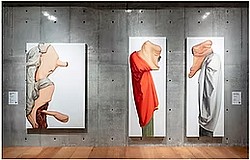
Gallery G-77
KG+
|
|
  |
18 Apr.Sat. – 3 May Sun.2026 In this exhibition Hayat and Pirsky present landscapes not as locations but as emotional spaces formed in the interval between material process and perception. Their images arise from a hybrid analog practice that includes expired Polaroid, manipulated negatives, chemical shifts, damaged emulsions, and fragments recombined with occasional digital intervention. Within this layered process the landscape becomes a site where memory and atmosphere emerge, suspended between what is recorded and what is felt. Their compositions often follow classical structure with firm horizons, balanced geometries, and a measured sense of depth. At the same time each image holds an interruption such as burns, tears, chemical blooms, shifting skies, or fragments of abandoned forms. These elements introduce an interval between order and entropy, between intention and material autonomy. The landscape is shaped not only by the artists but by time itself. What emerges is an emotional landscape where the absence of people becomes a form of presence. The earth continues on its own, independent and self contained, while meaning appears only in the space between the image and the viewer. Interval names this condition. It is the moment where nature remains itself and perception begins, where the landscape does not speak yet becomes resonant through looking. The viewer encounters not a place but a state of being, shaped within the interval between the outer world and inner experience. |
73-3 Nakano-machi Nakagyo-ku Kyoto,Japan 604-0086 Tel:090-9419-2326
Closed: Monday & Tuesday
Sokyo Gallery
<Sokyo>
Mika Horie Exhibiiton
|
|
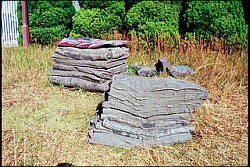 《Beyond the wind, beyond the cloud》、2025 |
5 Mar.Thu. – 2 Apr.Thu.2026 |
Tyler Coburn
|
|
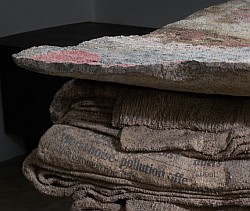 Photo:Tyler Coburn 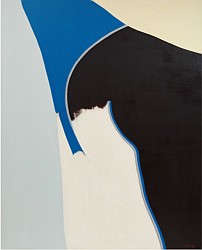 Photo:Tyler Coburn |
9 Apr.Thu. – 7 May Thu.2026
Performance: Saturday, April 11th, 11am - 12pm - Sokyo Gallery (Kyoto) is pleased to present Temptation by Space, American artist Tyler Coburn’s first show with the gallery. The exhibition comprises two projects—Candlestick Man (2023– ) and The Petrified (2022– )—that share an interest in speculation while respectively considering early Japanese-European cultural exchange and the politics of western heritage museums. Reflecting Coburn’s ongoing engagement with creative practitioners in Japan, Temptation by Space includes contributions by Taro Mizushima, Wataru Naganuma, and Jiro Sasaki. The front gallery hosts a new installation of Candlestick Man, which Coburn developed during the Tokyo Arts and Space International Creator Residency Program in 2023. Along one wall are several modern facsimiles of Oribe ware candlesticks, which depict the first Europeans to arrive in Japan in the sixteenth and seventeenth centuries. Largely fashioned by Jiro Sasaki, each has a Japanese candle (warosoku) that Coburn produced on a residency at Sokyo Gallery this March, drawing on techniques he learned from Kyoto workshop Nakamura Rosoku. The candles comprise haze wax—the traditional material for warosoku—as well as oil infused with lichens that Coburn collected from the site on Tanegashima where the Portuguese landed in 1543. On the opposing wall is a subtle sculpture by Coburn in the gofun of Kyoto manufacturer Ueba Esou. Misusing gofun as putty, Coburn copied the lichen dots from an early-seventeenth- century folding screen by Kanō Sanraku showing the Portuguese arriving in Nagasaki. During storytelling performances on the opening and closing weekends of the exhibition, Coburn and Wataru Naganuma will light some candles and use this wall as a prop, opening various sensory portals to the past. Enroute to the rear gallery are certain “backstage” elements of Candlestick Man. First, on a tatami display, sit two sculptures that Coburn and Sasaki made together in 2025: one of Coburn at Sasaki’s age at the time, and the other of Sasaki at Coburn’s age at the time (respectively, seventy and forty-one). Operating like nesting dolls, the men hold miniature versions of the candlesticks in the front gallery. Second, in a display nook, are shipping boxes and shaft-like sculptures of the same materials as the candles. Their shape mimics that of the copper ingots exported by Japan to China and The Netherlands in the seventeenth century. Ingots are intermediate forms designed to be melted and recast; in Temptation by Space, the ingots on view are a reserve supply of candle-making material. The rear gallery hosts The Petrified, an interdisciplinary project that imagines a parallel world in which, between 2009 and 2019, several people petrified in Western heritage museums. On a bench is a booklet of stories about these people that Coburn first published in e-flux journal in 2022. Written in a style of literary reportage, the texts draw on recent events and debates pertaining to cultural restitution and repatriation, the private financing of museums, and the politics of collecting and conserving. Visitors are invited to sit and read. The walls of the rear gallery display new additions to Coburn’s ongoing series of works on paper, expressing how the surfaces of the petrified bodies—as told in his stories—are speckled with the colors of the galleries they occupy. Coburn shot videos of those galleries then used 3D software to turn them into point clouds, which inspired his speckled technique. While in residence at Sokyo Gallery, he began using suihi-enogu to make this work, allowing the sediment to spread and settle in chance formations on the paper. At a key moment in Coburn’s stories, he describes a hollow, lifelike sculpture in The Metropolitan Museum of Art, New York fashioned using a dry-lacquer technique (kanshitsu). By way of pointing to this reference, Coburn has selected certain kanshitsu sculptures by Taro Mizushima for display throughout the rear gallery. Often roughly made and vaguely figurative, they stage a cryptic conversation with Coburn’s abstract yet bodily watercolors. The title of the exhibition, Temptation by Space, excerpts Roger Caillois’s 1935 essay “Mimicry and Legendary Psychasthenia.” In the text, the writer makes an analogy between insects that visually mimic their environments and the human desire to deindividualize and merge with what surrounds. This “temptation,” which Coburn references in his stories for The Petrified, may explain why his characters turn to stone in museums. It could also reflect the complexities of exchange in Candlestick Man, as various cultures negotiate their relative bounds and the possibilities that lie between them. |
Sokyo:381-2 Motomachi, Higashiyama-ku, Kyoto, Japan 605-0089
Tel:+81-75-746-4456 11:00am - 6:00pm Closed Sunday, Monday
Sokyo Annex:3F, SSS Building 375 Ichinofunairi-cho, Nakagyo-ku,kyoto
Tel:+81-80-747-4456 1:00pm - 6:30pm Closed Sunday, Monday
Gallery Ten
Shuzo Azuchi Gulliver
|
|
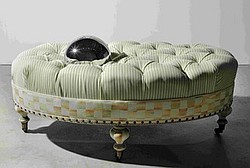 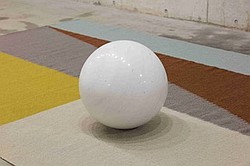 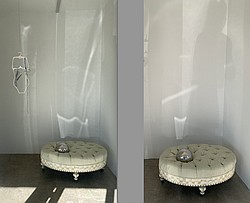 |
10 Jan.Sat. – 29 Mar.Sun. 2026 My weight can sit on the sofa.” (Shuzo Azuchi Gulliver) This exhibition will feature 10 to 15 works by Shuzo Azuchi Gulliver, with a focus on "Weight," one of his representative works. His large-scale solo exhibition "Breath Amorphous" was held in 2022 at BankART KAIKO + BankART Station (Yokohama), which is still fresh in our memories, but this exhibition will be his first solo exhibition in the Kansai area since the "EX-SIGN" exhibition at the Museum of Modern Art, Shiga (now the Shiga Prefectural Museum of Art) in 2010. Please come and see it. According to the artist himself, the title of the work, "Weight," is as follows: ‘Weight (Human Ball)’ (stainless-steel ball) has the same weight as the artist’s body. There are nine versions of the work based on the same concept (1978, 1979, 1980, 1982, 1983, 1985, 1987, 1988, 1990). (In 2022, ‘2022 version’ was produced with marble under the same concept.) [Below is the author's biography generated by AI/ChatGPT-4 in December 2025 (unedited)] Shuzo Azuchi Gulliver is a unique artist among postwar Japanese avant-garde artists. His work, while shifting in form, location, and media over the years, continues to explore fundamental questions about self and existence. While highly experimental and conceptual, his work incorporates performance and physicality, creating a strong connection with the audience. His works have been collected by museums both in Japan and abroad, and in recent years, they have been gaining recognition and re-evaluation. The 2022 "Breath Amorphous" exhibition is a prime example. He continues to garner attention both in Japan and abroad.
*Shuzo Azuchi Gulliver was born in 1947 in Hashimoto, Seta-cho, Kurita-gun, Shiga Prefecture (now
Seta, Otsu City). His real name was Shuzo Azuchi. He had a strong interest in art from a young
age, and while attending Shiga Prefectural Zeze High School, he began creating works incorporating
happening-like actions (e.g., "Grassfield" in 1964). His artistic practice included an early
dialogue with Western avant-garde and conceptual art, including an interest in philosophical and
theoretical thought and the influence of Marcel Duchamp. He employs a variety of media, including drawing, sculpture, installation, and performance. He is based in Tokyo and Europe, and is active both domestically and internationally. He continues to create art, exploring themes such as "existence," "self," "signs," "form," and "biological foundations. |
405-2 Sekisen’in-cho Higashiyamu-ku Kyoto, JAPAN
Tel/Fax +81-75-744-6533 Open only on Saturdays, Sundays and holidays